Unleashing the Potential of AI in Education: Personalized Learning and Streamlined Administration

The integration of Artificial Intelligence (AI) in the education sector is a transformative movement, poised to revolutionize the way learning is delivered and managed. AI promises to personalize learning experiences, streamline administrative processes, and create dynamic educational environments. This article will explore the multifaceted impact of AI in education, from customized learning paths to predictive analytics for decision-making, and how it can empower both students and educators.
Key Takeaways
- AI enables the creation of personalized learning materials and paths, enhancing student engagement and catering to individual learning styles.
- Through automation and data analysis, AI significantly increases administrative efficiency, reducing the workload on educational staff.
- AI tools provide valuable support in teacher-student interactions, offering bespoke feedback and facilitating equitable learning opportunities.
- Curriculum development benefits from AI with customized content, responsive materials, and integration of core learning frameworks.
- Emerging AI technologies promise to shape the future of education, driving trends like blended learning and managing educational change.
Personalized Learning through AI: A Paradigm Shift in Education

Customized Learning Materials and Paths
In the realm of education, Personalized Learning AI Solutions are revolutionizing the way students engage with their studies. These solutions tailor learning materials and paths to the individual needs and abilities of each student, ensuring that every learner can progress at their own pace and style. This bespoke approach not only enhances understanding but also ignites a passion for learning.
The benefits of personalized learning are manifold, and they can be seen across various dimensions:
- Adaptation: Learning materials adjust in real-time to the student's performance.
- Engagement: Interactive elements keep students motivated and involved.
- Efficiency: Students spend time on what they need, reducing unnecessary repetition.
- Support: Additional resources are provided when a student struggles with a concept.
Embrace the future of education with AI that understands and adapts to you. Personalized learning is not just a method; it's a journey towards educational empowerment.
As we delve deeper into the potential of AI in education, it's crucial to stay informed and ahead of the curve. The Bles Software website offers insights on leveraging AI for scalable growth, business expansion, SaaS innovation, and software development efficiency. Subscribe for AI, tech, and software solutions thoughts.
Virtual Coaching and Individualized Feedback
In the realm of education, AI's capability to provide virtual coaching and individualized feedback represents a monumental leap forward. Students now receive real-time, tailored guidance that adapts to their unique learning pace and style. This bespoke approach fosters a deeper understanding and retention of knowledge, as AI systems analyze performance data to pinpoint areas of strength and those requiring further attention.
The integration of AI into the feedback loop empowers learners to take charge of their educational journey, transforming passive absorption into active engagement.
The following list encapsulates the core benefits of AI-enabled virtual coaching:
- Personalized learning experiences that cater to individual student needs
- Continuous assessment and feedback loops that promote consistent improvement
- Data-driven insights that inform and enhance the learning process
By embracing these AI-driven educational tools, institutions can unlock unprecedented levels of personalization and efficiency. As we continue to explore the vast potential of AI in education, let us commit to leveraging these innovations to enrich the learning experience for all. The future of education is not just about technology; it's about the personalized, transformative experiences that technology can facilitate. Dive into the world of AI in education and be part of the revolution that is reshaping learning for the better.
Engagement and Interactivity in Learning Environments
In the realm of education, Virtual Learning with AI is not just a buzzword; it's a transformative force. AI for Student Engagement is redefining how students interact with content, teachers, and peers. By harnessing the power of AI, educators can create dynamic learning environments that are not only engaging but also highly interactive.
The key to unlocking the full potential of students lies in the intelligent integration of AI within the learning process. This integration fosters an environment where every click, every query, and every interaction is an opportunity for growth and engagement.
Here's how AI is making a difference:
- Customized learning experiences that adapt to individual learning styles and paces.
- Real-time analytics to monitor engagement and provide insights for improvement.
- Interactive simulations and gamification that make learning fun and memorable.
Embrace the future of education with AI. Let's create learning experiences that captivate, motivate, and inspire. Join us in this journey to elevate education to unprecedented heights. Are you ready to be a part of the change?
AI-Driven Administrative Efficiency in Educational Institutions

Streamlining Enrollment and Information Management
The dawn of the digital era has brought with it a revolution in how educational institutions manage the critical process of enrollment and information management. Automated student onboarding systems are now the cornerstone of a modern, efficient educational infrastructure, transforming the once cumbersome task into a seamless experience for both students and administrators.
- Automated Enrollment: Simplify the admission process with digital forms and databases.
- Data Integration: Ensure a unified system for student records across departments.
- Responsive Communication: Utilize AI to provide timely updates and responses to student inquiries.
Embrace the transformative power of AI to foster a welcoming and organized entry into the academic world.
The integration of Student Information Systems (SIS) and Learning Management Systems (LMS) has been pivotal, yet there is a pressing need to alleviate the administrative burden that often hampers our educators. By harnessing the capabilities of AI, we can not only streamline administrative tasks but also unlock new potentials for academic success. Let's not forget, the ultimate goal is to enhance the educational journey, making it as smooth and enriching as possible for every student. Stas provides exceptional AI learning experiences, ensuring that the practicality and relevance of these systems are deeply rooted in the understanding of AI concepts.
Automating Routine Tasks and Data Analysis
In the bustling corridors of educational institutions, AI-driven data analysis offers operational excellence, efficiency, and competitive advantage. By automating routine tasks, educators and administrators are liberated from the shackles of monotonous work, allowing them to focus on what truly matters: fostering a nurturing learning environment.
The implementation of AI schedule makers, for instance, is a testament to the transformative power of technology in education. These algorithmic maestros orchestrate the symphony of daily tasks with precision, from managing schedules to optimizing resource allocation. Consider the following benefits:
- Time and resource savings
- Money savings through efficient scheduling
- Deadline alerts and visual task management
- Streamlined collaboration and multi-device syncing
Embrace AI for transformative outcomes and business growth. Expert guidance is key.
Yet, the journey to integrate AI into educational administration does not come without its challenges. It requires a strategic approach, one that balances the pros of simplicity and automation with the cons of potential limitations in advanced features. The cost-benefit analysis is crucial, as illustrated below:
| Feature | Pros | Cons | Pricing |
|---|---|---|---|
| AI Scheduling | Streamlines tasks, easy to use | May lack advanced features | Varies |
| Task Automation | Enhances productivity | Requires customization | Affordable |
As we navigate the complexities of educational administration, let us not forget the ultimate goal: to enhance the learning experience for every student. AI is not just a tool; it is a partner in education. Let's harness its potential together.
Enhancing Decision-Making with Predictive Analytics
In the realm of education, AI for Education Analytics is not just a buzzword; it's a transformative force. Predictive analytics, powered by AI, is reshaping how educational institutions make decisions. By analyzing vast amounts of data, AI systems can forecast trends, identify at-risk students, and suggest interventions to improve outcomes.
The integration of AI into decision-making processes allows for a level of precision and foresight that was previously unattainable.
Educators and administrators are now equipped with tools that can predict student performance and institutional needs with remarkable accuracy. Consider the following benefits:
-
Proactive Intervention: AI identifies patterns that signal a student may be struggling, enabling timely support.
-
Resource Allocation: Predictive models inform where to best allocate resources for maximum impact.
-
Strategic Planning: Long-term trends are revealed, aiding in the development of robust educational strategies.
The table below succinctly captures the impact of AI on key decision-making areas:
| Area of Impact | Before AI | With AI |
|---|---|---|
| Student Success | Reactive Measures | Proactive Analytics |
| Operational Efficiency | Manual Analysis | Automated Insights |
| Strategic Growth | Historical Data | Predictive Modeling |
Embrace the power of AI for Education Analytics to unlock a future where every decision is data-driven, every strategy is informed, and every student's potential is maximized. The time to act is now—let AI guide your institution towards a smarter, more efficient, and more successful future.
Revolutionizing Teacher-Student Interactions with AI Tools

Facilitating Bespoke Feedback and Assessment
In the realm of education, AI-Assisted Tutoring Systems are revolutionizing the way feedback and assessments are conducted. These systems provide a level of personalization previously unattainable, tailoring feedback to the unique needs of each student. With AI, educators can now offer bespoke feedback that is both timely and relevant, fostering an environment where students are continuously engaged and supported in their learning journey.
The transformative power of AI in education lies in its ability to adapt to the individual learning styles and pace of students, ensuring that each learner receives the attention they deserve.
Moreover, AI systems can track and analyze student performance over time, offering insights that go beyond traditional grading systems. This data-driven approach allows for a more nuanced understanding of student progress and areas for improvement. Consider the following aspects of AI-driven feedback:
- Comprehensive analysis of student work
- Real-time feedback that accelerates learning
- Predictive insights that guide future instruction
By embracing AI in the feedback loop, educational institutions can unlock the full potential of their students, paving the way for a future where personalized education is the norm. As we continue to explore the capabilities of AI in education, let us not forget the profound impact it can have on shaping the minds of future generations. The call to action is clear: integrate AI into your educational practices and witness the transformation unfold.
Empowering Educators with Professional Development Tools
In the realm of education, empowering educators is pivotal for fostering a nurturing and effective learning environment. Educational AI Software Development is at the forefront of this empowerment, offering AI-Enabled Teaching Tools that transform the traditional teaching landscape. These tools are not just about enhancing the delivery of content; they are about enriching the entire pedagogical approach.
Educators are now equipped with a suite of AI tools that provide actionable insights into student performance, enabling them to tailor their teaching strategies to individual needs. This personalized approach ensures that no student is left behind, and every educator feels supported in their professional journey.
The integration of AI in professional development is not a distant future—it's a present reality. It's time to embrace these advancements and witness a significant uplift in educational outcomes.
Consider the following benefits of AI-Enabled Teaching Tools:
- Real-time data analysis for informed teaching decisions
- Virtual simulations for hands-on experience in a safe environment
- Continuous professional growth through adaptive learning platforms
By leveraging these tools, educators can stay ahead of the curve, ensuring they are well-prepared to meet the challenges of modern education. The call to action is clear: embrace Educational AI Software Development to unlock the full potential of both teachers and students.
Creating Collaborative and Equitable Learning Spaces
In the quest to create learning environments that are both collaborative and equitable, AI stands as a transformative ally. AI tools are democratizing education, ensuring that every student has access to the resources and support they need to thrive. By leveraging AI, educators can design spaces that foster inclusivity and teamwork, breaking down traditional barriers to learning.
- Personalized Learning: AI facilitates learning experiences tailored to individual needs, promoting equity in education.
- Diverse Perspectives: AI-driven platforms can expose students to a wide range of ideas and cultures, enhancing collaborative learning.
- Accessibility: Advanced AI technologies make learning materials accessible to students with disabilities, ensuring no one is left behind.
The true power of AI in education lies not just in its ability to teach, but in its capacity to bring students together, creating a shared space of discovery and growth.
As we embrace these AI-enabled collaborative spaces, we must also recognize the role of companies like Stas Sorokin on Fiverr Pro, who are at the forefront of integrating AI within our educational frameworks. Their expertise in web app development, including chatbots and API integration, is pivotal in crafting the interactive and inclusive learning environments of tomorrow. Let's not just imagine the future of education; let's build it together. Engage with AI in your institution and witness the transformation firsthand.
AI in Curriculum Development and Management

Curriculum Customization and Auto-tagging
In the realm of education, curriculum development is no longer a static process. AI has introduced a dynamic element to curriculum design, allowing for real-time customization and auto-tagging of learning materials. This innovation not only streamlines the process but also ensures that the curriculum remains relevant and engaging for each individual learner.
With AI, educators can now map out a curriculum that adapts to the changing needs and abilities of students, creating a truly personalized learning journey.
The benefits of curriculum customization are manifold. Here's a glimpse into the transformative impact AI has on curriculum development:
- Adaptive Learning: AI algorithms analyze student performance and learning styles to tailor the curriculum accordingly.
- Efficiency: Auto-tagging saves countless hours by automatically categorizing content, making it easily searchable and accessible.
- Engagement: Customized content means students are more likely to find the material relatable and interesting, which can lead to better retention and outcomes.
As we continue to explore the potential of AI in education, it's clear that the tools we develop today will shape the learning experiences of tomorrow. Embrace the change, and let AI take your curriculum to the next level. Are you ready to be part of this educational revolution?
Responsive and Adaptive Learning Materials
In the realm of AI in Educational Technology, the development of responsive and adaptive learning materials stands out as a transformative force. These AI Adaptive Learning Systems dynamically adjust to the individual learner's pace, style, and level of understanding, ensuring that each student's experience is uniquely tailored to their needs.
The integration of AI in Classroom Innovation has led to the creation of learning environments that are not only interactive but also deeply personalized. This is a pivotal step towards achieving true AI for Education Accessibility.
By leveraging AI in Education Management, educators can now provide a more inclusive and equitable learning experience. The following list highlights the key benefits of responsive and adaptive learning materials:
- Personalization of learning experiences
- Real-time feedback and adjustments
- Data-driven insights into student performance
- Enhanced engagement through interactive content
As we continue to explore the potential of AI in education, it is crucial to recognize the role of these systems in democratizing learning. The call to action for educators and technologists alike is to embrace these innovations, ensuring that every student has access to high-quality, personalized education.
Integrating Core Learning Frameworks with AI
The integration of core learning frameworks with AI is not just an advancement; it's a complete transformation of the educational landscape. AI-Driven Learning Platforms are at the forefront of this change, offering dynamic and responsive environments that adapt to individual learning styles and needs. AI in Curriculum Design goes beyond mere digitization of materials, it involves the creation of intelligent pathways that evolve with the learner.
By harnessing the power of AI, educators can ensure that the curriculum is not only comprehensive but also deeply engaging and continuously relevant to students' personal and professional growth.
The following table illustrates the capabilities of AI in enhancing various aspects of knowledge management and learning systems:
| Feature | AI-Driven Enhancement |
|---|---|
| Cataloging/Categorization | Automated and precise |
| Content Management | Dynamic and adaptive |
| Decision Tree | Intelligent pathways |
| Knowledge Base Management | Self-evolving with user interaction |
| Self Service Portal | Personalized user experience |
In conclusion, the potential of AI to revolutionize education is immense. It's time to embrace these technologies and prepare for a future where learning is deeply personalized, highly efficient, and universally accessible. Let's not just witness the revolution; let's be a part of it.
The Future of AI in Education: Trends and Innovations
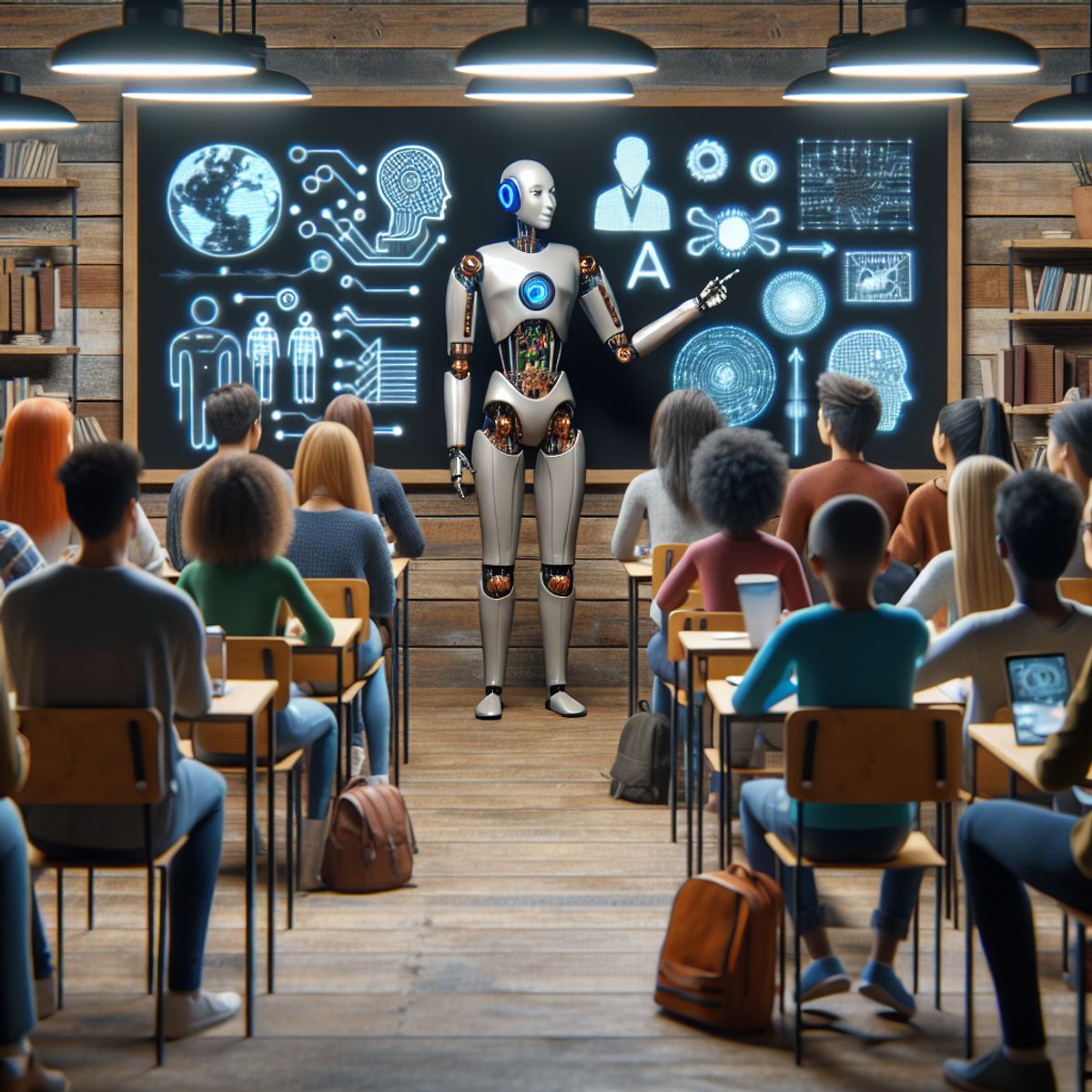
Blended Learning and Interactive Classrooms
The integration of AI into blended learning environments is transforming the educational landscape, offering a seamless fusion of traditional and digital pedagogies. Blended learning models are now more adaptive and responsive, thanks to AI's ability to analyze learning patterns and tailor content accordingly.
In these interactive classrooms, every student's experience is unique, sculpted by AI to fit their learning pace and style.
Educators are leveraging AI to create dynamic learning spaces where students engage with both online and offline resources. Here's how AI is making a difference:
- Enhanced Personalization: AI algorithms provide recommendations for individual learning paths.
- Real-Time Feedback: Immediate assessment and feedback are possible with AI-driven tools.
- Collaborative Learning: AI facilitates group projects and discussions by suggesting relevant topics and resources.
The call to action for educators and institutions is clear: embrace AI to enrich the learning experience. By doing so, they not only cater to the diverse needs of students but also prepare them for a future where technology and human ingenuity are intertwined. Let's not just imagine the future of education; let's build it together.
The Role of AI in Managing Educational Change
The AI Impact on Education is profound, reshaping the very fabric of how institutions operate and evolve. AI tools drive operational efficiency, enhancing every facet of the educational landscape. From streamlining administrative processes to personalizing student experiences, AI is the catalyst for transformative change.
Embracing AI in education is not merely about adopting new technologies; it's about redefining the ecosystem to be more responsive, inclusive, and innovative.
AI-driven solutions are pivotal in managing the complexities of educational change. They offer a systematic approach to handling the dynamic needs of students and educators alike. Consider the following:
- Strategic Planning: AI provides data-driven insights for long-term educational strategies.
- Adaptive Systems: Institutions can rapidly adjust to new learning methodologies.
- Stakeholder Engagement: Enhanced communication channels between students, teachers, and parents.
Lydonia Technologies leads with AI-driven capabilities, emphasizing human oversight for strategic decision-making. This balance ensures that while AI propels us forward, it is the human touch that guides the journey. As we look to the future, the integration of AI in education promises a more agile, personalized, and effective learning environment. Let us harness this potential together and pave the way for a brighter educational future.
Emerging AI Technologies in Academic Talent Management
The advent of AI in academic talent management is not just an incremental change; it's a revolutionary leap towards a future where educational institutions can harness the full potential of their human capital. AI's role in this domain is multifaceted, from enhancing the job search process to personalizing career development for educators and staff.
AI-driven tools are now capable of analyzing job data, aligning candidates with suitable opportunities, and optimizing recruitment processes. This not only streamlines the hiring cycle but also ensures a more precise match between institutional needs and candidate capabilities. Imagine a world where the tedious task of sifting through applications is replaced by an intelligent system that can predict the best fit for your team.
The integration of AI in talent management transcends traditional boundaries, offering a personalized approach that resonates with both job seekers and employers.
Moreover, AI can play a pivotal role in employee retention, a critical metric for any institution. By automating scheduling and providing tailored career development recommendations, AI technologies foster a supportive environment that values each individual's growth and contribution.
To truly embrace the potential of AI in academic talent management, consider these key points:
- AI revolutionizes inventory and marketing with personalized experiences, predictive stock management, and dynamic campaigns.
- Embrace AI for operational efficiency and competitive advantage in business operations.
The journey towards integrating AI in talent management is just beginning. As we continue to explore and implement these technologies, the landscape of education will be transformed, offering unprecedented opportunities for growth and innovation. Don't miss out on this transformative wave—embrace AI and unlock the potential of your educational institution.
Conclusion
The integration of artificial intelligence into the educational landscape heralds a transformative era for both learners and educators. As we have explored, AI's capacity to personalize learning experiences, streamline administrative processes, and enhance interactive educational environments is not just a futuristic vision but an attainable reality. The myriad of AI applications, from virtual coaching to data-informed decision-making, underscores a paradigm shift towards more efficient, engaging, and equitable education systems. The success stories of institutions leveraging AI, such as Liaison International and Illuminate Education, serve as beacons for the potential that lies within this technological integration. As we continue to navigate the complexities of educational needs, AI stands as a formidable ally, promising to reshape the very fabric of learning and teaching. It is incumbent upon us to harness this potential responsibly, ensuring that the benefits of AI in education are accessible to all and aligned with the core values of educational excellence.
Frequently Asked Questions
How does AI personalize learning experiences for students?
AI personalizes learning experiences by analyzing student data and behavior to create customized learning materials and paths, providing individualized feedback, and adjusting in real-time to the student's learning pace and style.
What administrative tasks can AI automate in educational institutions?
AI can automate a range of administrative tasks such as enrollment processing, information management, routine data analysis, and even assist in decision-making through predictive analytics.
In what ways can AI enhance teacher-student interactions?
AI can facilitate bespoke feedback and assessment, empower educators with professional development tools, and create collaborative and equitable learning spaces that cater to diverse student needs.
How is AI used in curriculum development and management?
AI aids in curriculum development by customizing and auto-tagging learning materials, creating responsive and adaptive content, and integrating core learning frameworks to ensure educational relevance and effectiveness.
What are some emerging AI technologies in education to look out for?
Emerging AI technologies include blended learning platforms, interactive classrooms, AI in talent management, and tools for managing educational change and fostering student engagement throughout the learning lifecycle.
Can AI improve the outcomes of online and blended learning environments?
Yes, AI can significantly improve outcomes by providing personalized content recommendations, fostering credibility with proctorless remote monitoring, and creating smart practice spaces for productive learning.


Comments
Post a Comment